
SEND/Inclusion
Inclusion
Holmer Green Junior School Inclusion Team
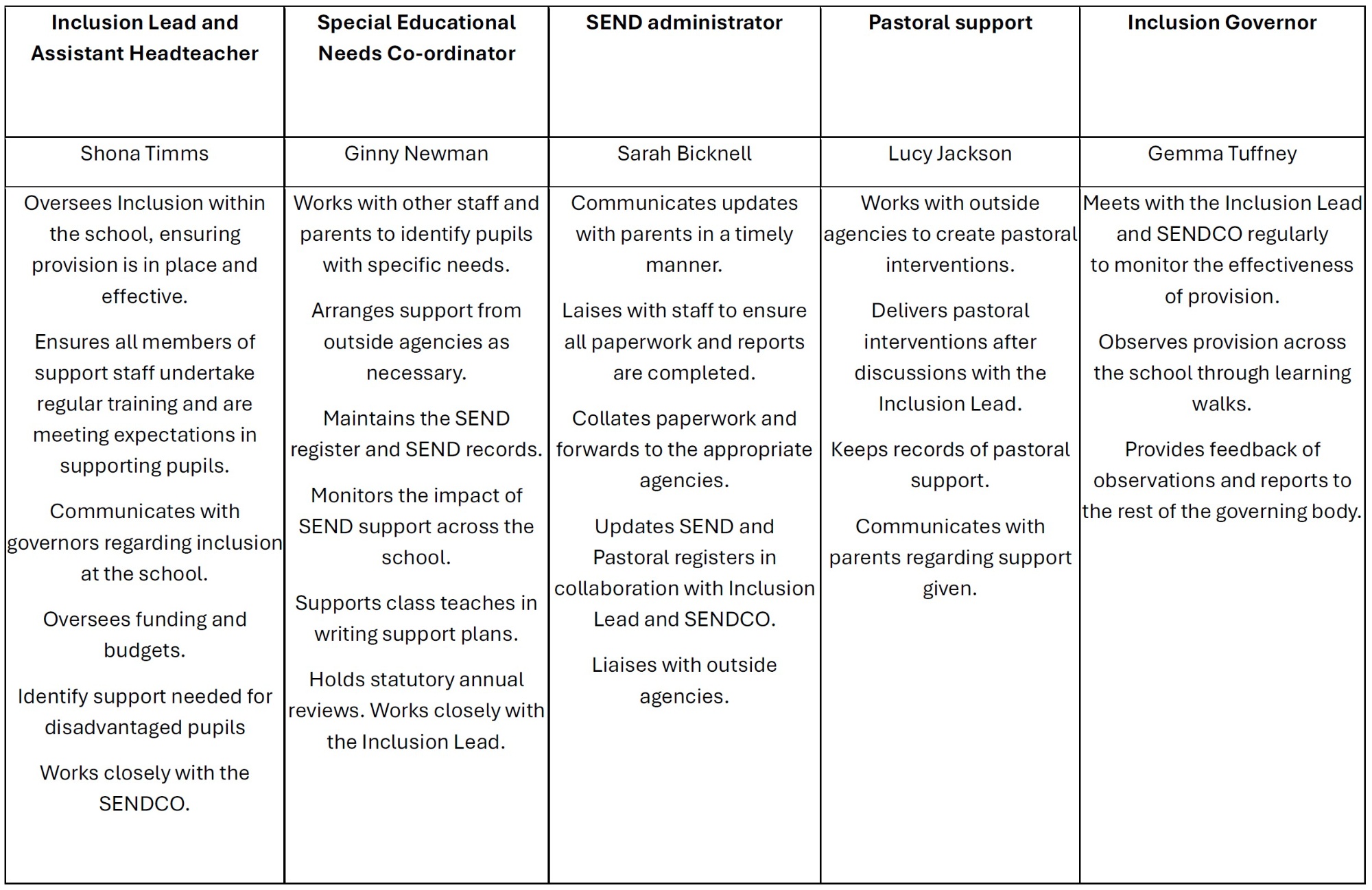
It is important for us to reflect on the positive changes that we have made regarding inclusion at Holmer Green Junior School. Key changes that we have made are:
- An expanded Inclusion team which includes: An Inclusion Lead, SENDCO, SEND administrator and pastoral support
- The chance for a wider range of parents and guardians to get into school more regularly as the SEND coffee mornings have been expanded to pastoral care as well
- Opportunities for all communications to be responded to in a timely manner and staff to be able to communicate more regularly with parents/carers about their child's inclusion needs
- Chances for parents and guardians to get direct guidance from outside agencies such as the Mental Health Support Team, the Inclusion Specialist Teacher Service and Family Support
- Continued links with the Mental Health Support Team with them providing a range of interventions and support for pupils and families
- An increased focus on the mental wellbeing of all pupils
- A wider range of targeted nurture groups
- Greater one-to-one tuition for pupils entitled to targeted pupil premium support.
We are grateful for the support and feedback that we have gained from the school community and look forward to continuing to improve together.
Shona Timms
Assistant Headteacher and Inclusion Lead
Holmer Green Junior School
Intent
At Holmer Green Junior School, we are committed to providing quality education for all pupils, including those with SEND. We believe that all children are able to achieve wonderful things when they are given the opportunity and the support to do so. At our school, we provide pupils with the skills, knowledge and vocabulary to thrive and understand that we may need to provide extra support to ensure that this happens.
We cater for pupils with a wide range of SEND needs including children with: ASD, Speech, Language and Communication needs, hearing impairments and Down’s Syndrome. Here, inclusion is key. Across the school, our focus is on creating a community where all children are inspired to be the best that they can be, are enabled to reach their goals and can achieve.
A key aim in the SEND Code of Practice is preparing pupils for making a successful transition into adulthood. This is one of our main focuses as a school.
Implementation
At Holmer Green Junior School, we will achieve this by:
- Providing Quality First Teaching to all pupils;
- Working closely with parents and carers;
- Ensuring that all staff have regular training;
- Inclusion strategies being discussed in staff meetings every week;
- Providing individual SMART targets which are updated regularly;
- Using programmes such as Speech and Language Link;
- Scaffolding learning in lessons;
- Working with outside agencies such as CAMHS, Speech and Language Therapy team, Occupational Therapy, Specialist Teaching Service ASD team, STS Down’s Syndrome team, Mental Health Support Team;
- Completing targeted interventions with pupils;
- Celebrating all achievements;
- Supporting pupils during un-structured times;
- Regular meetings between the class teachers and the SENDCo;
- Creating knowledge rich lessons which focus on over learning;
- Providing one-to-one or group ELSA sessions for pupils with a mental health need;
- Using Zones of Regulation throughout the school;
- Having a broad curriculum that allows pupils to develop a range of knowledge that engages all pupils;
- Completing SMART (Specific, Measurable, Achievable, Realistic, and Timely) targets with pupils on the SEND register;
- Opportunities for all pupils to work with an adult and to have the opportunity to work independently
Impact
A support plan is created for all pupils on the SEND register. We use an assess, plan, do review cycle to ensure that all children are making progress, even if this progress is made up of small steps. SMART targets are created and reviewed regularly to ensure that all pupils feel successful. Pupil progress is measured using both formative and summative assessments. In class, teachers use work in books as well as observations to make decisions about whether pupils are making the expected progress. PiXL tests are used to make summative assessments as well as assessments through programmes such as Language Link. If ELSA support is provided, goals will be outlined at the start of the six weeks of support and these will be worked towards during the intervention.
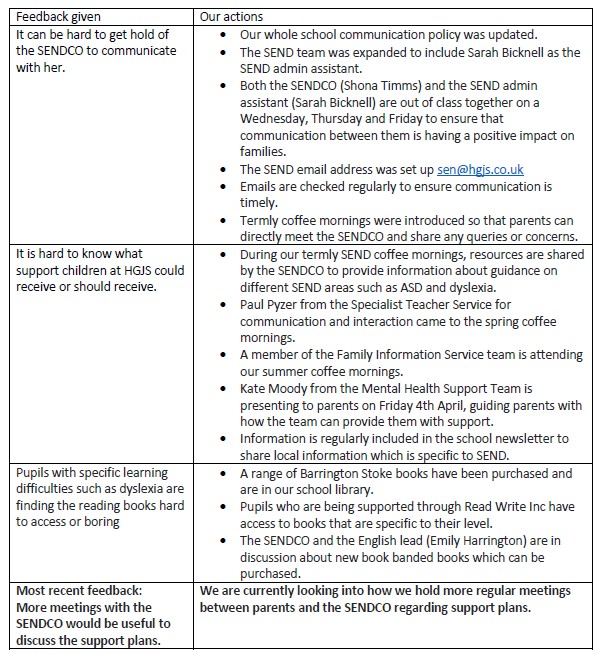
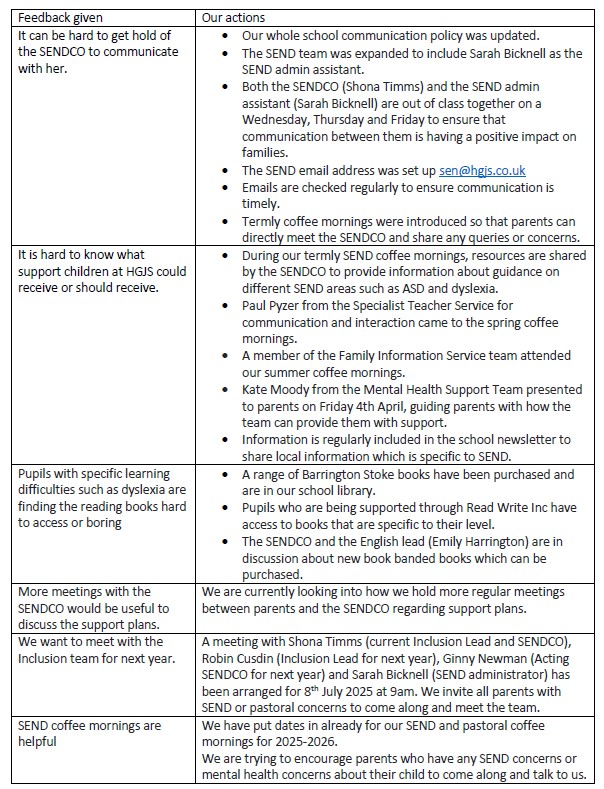
At HGJS, our aim is to ensure that communication between home and school is as effective as possible. We are eager to receive feedback which we can act on. Below is a summary of some of the feedback that we have been given and the ways in which we have used it to improve.
Our SENDCO, Shona Timms and the SEN Administrator can be contacted via sen@hgjs.co.uk
Bucks SEND support line - 01296 382135
The Bucks SEND support line is open everyday between 10am and 4pm and until 6pm on Tuesdays. During the school holidays, the support line is open between 10am and 2pm. It is closed on bank holidays. The line is for parents, professionals and anyone with enquiries about SEND in Buckinghamshire.